One Person, Full Attention: The Art of Being Magnetic Without a Microphone
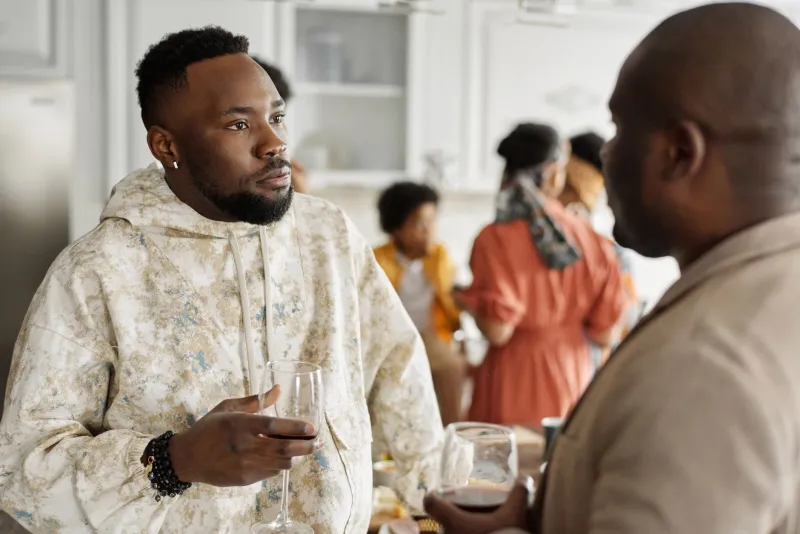
Here's a confession: I've performed in front of crowds that could fill a high school gymnasium, and I've completely lost a single person sitting three feet away from me at a cocktail party. Both situations stung. But only one of them taught me something genuinely useful.
There's this assumption that if you can work a room from a stage, you can automatically work a room at a networking mixer or a holiday dinner. That's not how it goes. A stage gives you a lot of scaffolding — lighting, a microphone, the social contract that says everyone agreed to watch you. Strip all that away, and you're just a person trying to be interesting to another person. That's a completely different skill, and almost nobody talks about how to actually develop it.
I've spent a long time thinking about this. Because the truth is, the most career-defining conversations I've ever had didn't happen in front of an audience. They happened in a booth at a diner, at someone's backyard barbecue, or in the ten minutes before a show when I was talking to the one person who happened to book me. Learning to be genuinely compelling in those moments? That changed everything.
Forget the Performance Instinct — At First
The biggest trap performers fall into in social settings is defaulting to performance mode. You know the type. They get louder, they start projecting, they turn every exchange into a bit. People can feel the effort, and it creates distance instead of connection.
The first technique I had to unlearn was the instinct to entertain at someone instead of with them. On stage, you're broadcasting. In a one-on-one conversation, you're in a dialogue — and the moment the other person feels like an audience member rather than a participant, you've already lost them.
So the starting point isn't about what you say. It's about how present you actually are. And presence, real presence, looks a lot like genuine curiosity.
Ask the Question Behind the Question
Most people at networking events or dinner parties ask the same surface questions. What do you do? How do you know the host? Where are you from? These questions aren't bad, but they don't open anything up. They're conversational formalities, not invitations.
What I started doing — and this came directly from years of interviewing guests and reading audiences — is listening for the thing underneath what someone says, and asking about that.
If someone says they just moved back to their hometown after fifteen years away, I'm not asking oh, do you like it? I'm asking what made you finally pull the trigger on that? That question reaches for the real story. And people almost always have a real story they're dying to tell — they just need someone to ask for it properly.
This is the performer's instinct applied correctly: we're trained to find the emotional core of a moment. In conversation, the emotional core is almost never in the first answer someone gives you.
The Power of the Slow Reaction
Here's something I picked up from watching great interviewers work: don't rush to respond. When someone finishes telling you something, most people immediately launch into their own related story or opinion. It's reflexive. We're all waiting for our turn.
But if you pause — even just for two or three seconds — something interesting happens. The other person often keeps going. They add a detail they almost didn't share. They get to the part of the story that actually matters to them. And suddenly you know something real about them that the seventeen other people they talked to that night don't know.
That pause also signals something powerful: I'm actually thinking about what you just said. In a world where everyone's half-distracted, that kind of attention feels rare. It feels good. And people remember how you made them feel long after they've forgotten what you said.
Make Your Observations Specific
Generic compliments and generic observations create generic connections. That's so interesting is conversational wallpaper. But if you say wait, the way you described that — it sounds like you actually loved the chaos of that job even when you hated it — now you've reflected something true back to them. That's intimacy. That's the feeling of being genuinely seen.
Performers understand the power of specificity on stage — a joke about the DMV in Burbank lands harder than a joke about bureaucracy. The same principle works in conversation. When you make a specific observation about what someone just shared, it proves you were actually listening. And being listened to is one of the most underrated things one human being can offer another.
Hold the Space, Don't Fill It
One of the counterintuitive lessons performing taught me is that silence isn't dead air — it's a container. On stage, a well-placed pause builds tension, signals that something important is coming, and keeps an audience leaning in. In conversation, it does the same thing.
A lot of people are so uncomfortable with silence that they rush to fill it with noise — more words, a joke, a subject change. But if you can sit comfortably in a brief quiet moment, you signal confidence and ease. You're not scrambling. You're not nervous. You're just... there. That calm is magnetic in a way that constant talking never is.
The One-Person Audience
Here's the reframe that tied all of this together for me: in a one-on-one conversation, the other person is your audience. Your only audience. And the best performers I've ever seen — the ones who can hold a room of five hundred people — do it by somehow making every single person feel like they're the only one there.
That's not a trick. It's a commitment to presence. It's deciding, for the duration of this conversation, that this person in front of you is the most interesting thing happening in the room. When you make that choice — and it is a choice — people feel it. They lean in. They open up. They remember you.
The spotlight is a tool. But attention — real, undivided, generous attention — is a gift. And it turns out, it's the most powerful one in the whole toolkit.
You don't need a stage to be compelling. You just need to show up for the person in front of you. Completely, specifically, and without an agenda.
That's the skill nobody teaches you. And honestly? It might be the most important one I've ever learned.