Read the Room, Then Leave It: The Quiet Power of Knowing When to Walk Away
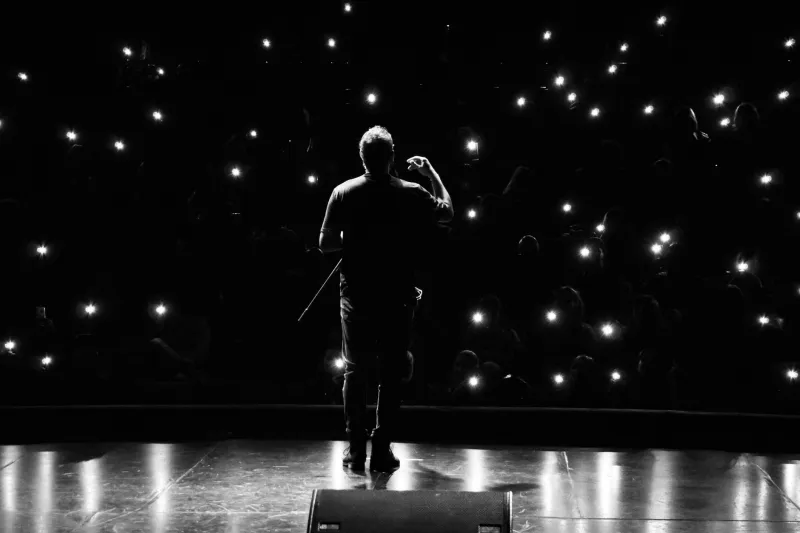
There's a story — probably apocryphal, definitely instructive — about a veteran comedian who once killed it at a club in Chicago. The crowd was with him completely. Every joke landed. The energy in the room was electric. And then, about forty minutes in, he just... stopped. Thanked the audience, walked off, and refused to do an encore.
Backstage, someone asked him why he cut it short when the crowd was still hot.
He said, "Because they were still hot."
That right there is the lesson. And it took me an embarrassingly long time to actually learn it.
The Trap of the Warm Room
When things are going well on stage, the natural instinct is to keep going. The crowd is laughing, the energy is flowing, and you feel invincible. Why would you stop now? That feeling is intoxicating. It's also dangerous.
Here's what nobody tells you early in your career: audiences have a ceiling. There's a peak moment — a specific, fleeting point where the connection between performer and crowd is at its absolute maximum. After that peak, even if the material stays strong, the emotional return starts to diminish. The laughs get a little smaller. The applause is still there, but it's more polite than electric. You've crossed from "I want more of this" territory into "okay, I think I'm good" territory.
The problem is that peak moment feels identical to every other good moment when you're standing in it. You can't always tell from the inside. That's what makes this skill so hard to develop — and so valuable once you do.
Timing Is More Than a Punchline
Comic timing gets a lot of attention. There are books about it, workshops dedicated to it, entire comedy theory frameworks built around the pause before the punchline. But timing isn't just about when you say the thing. It's about when you stop saying things altogether.
Think about the performers who genuinely mastered this. Johnny Carson was famous for his exits. He'd close The Tonight Show in a way that left you wanting just a little more — that was intentional. Dave Chappelle walked away from a $50 million deal at the height of his fame, and while the reasons were complex, the effect was that the world never stopped talking about him. Prince notoriously kept his catalog off streaming platforms for years. The absence created desire.
These aren't accidents. They're strategies, even if they don't always feel like it in the moment.
The Psychology of Strategic Absence
There's actual science behind why restraint works. Psychologists call it the "Zeigarnik effect" — the tendency for people to remember incomplete experiences more vividly than complete ones. When you end something before the audience is fully satisfied, their brain keeps working on it. They carry you with them when they leave the room.
Contrast that with the performer who overstays their welcome. You've seen this. The set that goes fifteen minutes too long. The speaker who had three perfect stopping points but took none of them. The entertainer who circles back to a bit that already landed beautifully, trying to squeeze one more drop out of it. What happens? The audience mentally checks out. The memory they carry isn't the peak — it's the tail end, where things got a little tired.
You don't want to be remembered for your tail end.
What "Stopping" Actually Looks Like in Practice
This isn't just about stage exits. The principle applies across the full spectrum of how a performer or creator shows up.
In a live set: Learn to identify your second-to-last laugh, not your last one. That's your exit point. Leave them wanting the laugh they didn't quite get.
In conversation: The entertainer who dominates every social interaction eventually becomes background noise. The one who asks a great question and then actually listens becomes magnetic. Stepping back is a form of presence, not an absence of it.
In your content: Not every story needs a tidy bow. Not every video needs a full three-act structure. Sometimes the most powerful thing you can post is something that ends a beat before the audience expects it to. That slight dissonance is what makes people hit replay.
In your career: Saying no to an opportunity — especially a visible one — can communicate more about your value than saying yes to everything. Scarcity, when it's genuine and intentional, creates demand.
The Hardest Part: Trusting the Silence
Here's the real obstacle. Stopping requires trust. Trust that the audience will fill the silence with something better than whatever you were about to say. Trust that leaving them at a high point is more respectful than grinding every last laugh out of the room. Trust that your worth isn't measured in minutes on stage.
For a lot of performers — myself included, for way too many years — that trust is hard to come by. When you've worked for an opportunity, the instinct is to maximize it. Use every second. Leave nothing on the table. But that's a scarcity mindset disguised as hustle, and it usually produces exactly the opposite of what you want.
The performers who seem effortlessly confident? They've learned to trust the exit. They know their value doesn't evaporate the second they walk off stage. If anything, it grows.
A Practical Exercise Worth Trying
Next time you're preparing a set, a presentation, a video, or even a dinner party story — identify the moment you think you have to get to. The big finish. The final point. The punchline you've been building toward.
Now ask yourself: what happens if I stop one beat before that?
Sometimes the answer is: nothing good, I need that ending. But sometimes — more often than you'd expect — you'll find that the setup is the payoff. That the anticipation was the experience. That the audience was already there, and you were just adding noise.
Try cutting it. See what happens.
The Exit Is Part of the Performance
Every entertainer spends enormous energy on the entrance. The opening bit, the first impression, the hook. And that matters — a lot. But the exit? That's what stays with people. That's the last emotional imprint you leave.
The best performers I've ever watched understood that walking away at the right moment isn't giving up. It's the final act of a performance that was built to be remembered. It says: I respect your attention too much to waste it.
That's not restraint. That's craft.
Know when to go. And when you go, go clean.